
The Lure
The Lure is a cosmic horror walking simulation about a detective looking for his missing colleague through a series of loops, and ending up in a supernatural entity that mimic a house.

Main Task
-
Establish cores mechanics and gameplay loop
-
Create 2D plans
-
Create blocking layout
-
Establish the key points of the narrative
-
Create and integrate scripted events
-
Supervise playtest sessions
-
Test the game: collision, readability, bugs

Breaking traditional design codes
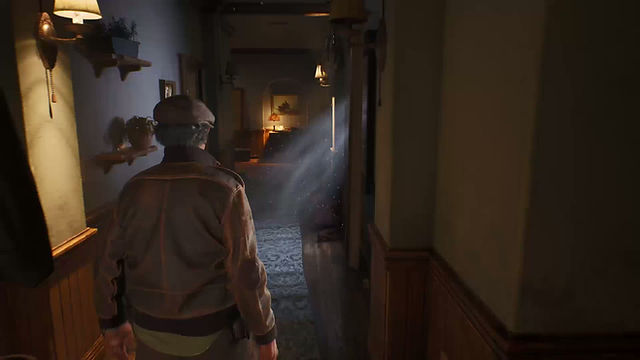
Breaking player empowerment
Firstly, our game belongs to the cosmic horror genre. We wanted the player to feel powerless and vulnerable against the entity that mimics the house.
Instead of becoming stronger throughout the game, the player gradually grows weaker. As the entity’s corruption spreads through him, it begins to affect him physically.
The player is slowly dying, which is reflected in the character’s animations and movement speed.
Making the navigation surprising
Secondly, the entity attempts to replicate reality in order to lure the player deeper into the house. However, it doesn't quite succeed.
The player finds themselves looping through the same hallways and rooms. As the loops continue, the arrangement of corridors and rooms continuously shifts, making navigation unpredictable and slightly disorienting.
Furthermore, the environment gradually distorts, creating a growing sense of unease and causing the player to question their memory, perception, and spatial awareness.


Making the environment hostile

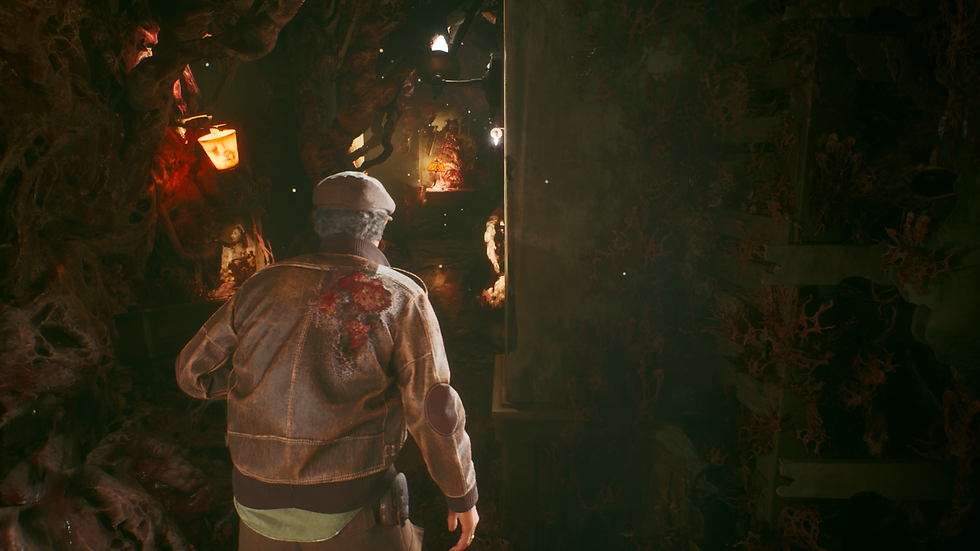

Thirdly, the house itself is designed as a living and hostile entity, and this idea is reflected directly through the environment design. As the player ventures deeper into the house, the entity gradually reveals its true nature.
To reinforce the feeling of danger and uncertainty, I used obstructed sightlines, sharp angles, and verticality to prevent the player from getting a full view of the house. This layout also creates opportunities for staged scripted events.
Toward the end of the experience, the architecture becomes increasingly oppressive and organic. The player is forced to navigate through narrow corridors made of flesh-like structures, designed to make the player feel uncomfortable.
Design behind each loop

Loop 01
The first loop is designed to introduce the player to the controls and core game mechanics. The house appears normal and inviting, while the narrative and environment gradually reveal the context and the player’s objective.
This section has a slower pace, allowing the player to become familiar with the controls, atmosphere, and surroundings. I primarily used lighting changes to guide the player through this loop.
Loop 02
The second loop introduces the player to the corruption. Touching it allows the player to collect items essential for progression, but it also affects the player’s health, causing a slight reduction in movement speed along with visual changes. At this stage, the house begins to display subtle inconsistencies. The player may notice moving veins, and several environmental objects have changed compared to the first loop.
This loop is designed to make the player realize that the house is strange and that something unusual is happening. It is also the first time the player returns to the initial hallway and living room, reinforcing the idea that they are trapped in a loop.

Loop 03

Toward the end of the second loop, the layout becomes inconsistent and begins to reveal anomalies. The third loop amplifies this effect by guiding the player through the rooms along a new path and altering the dining room while the player is inside it. This loop is designed to disorient the player and make them question whether they will be able to escape this place alive.
At this stage, the corruption and living matter have become far more prominent. The player grows increasingly corrupted, while the clues related to the investigation become more obscure, shifting the narrative’s focus toward survival and the hope of escaping alive.
I initially used sound to guide the player toward the phone, then relied on lighting and composition to lead them through the rest of the loop.
Loop 04
The fourth loop is designed to make the player feel uncomfortable. The architecture is now composed of flesh and veins, creating a more oppressive and disturbing atmosphere. This loop also aims to surprise the player and evoke a sense of paranoia, making them feel as though they are being followed.
To achieve this, human-shaped veins move and appear when the player is not looking. If the player is attentive, they can also hear footsteps coming from the mezzanine and see a clone of themselves walking by.

Ending

The final loop is designed to intensify the same emotions established in the previous one. I continue using scripted events to alter the environment and make human-shaped veins appear when the player is not looking. I also placed the clone at the end of the hallway to ensure the player notices it.
Seeing their own character at the end of the corridor raises several unanswered questions and leaves the ending open to interpretation. However, I still subtly guide the player toward a specific path: when they see their clone, the character says, “No, wait, don’t go there,” which sounds strangely similar to the voice the player hears when starting the game for the first time.
Bringing feels through scripted events
Bringing the environment to life
In horror games, it is important to include events that build tension and surprise the player. We also wanted the player to gradually suspect that the house itself is alive.
To achieve this, I implemented dynamic environmental elements, such as doors slamming shut behind the player, picture frames falling from the walls on their own, and veins receding as the player approaches.


Play with the player's mind
We wanted to create uncertainty and surprise the player at various moments throughout the experience. To achieve this, I used a component developed by my colleague that determines whether objects are within the player’s field of view.
This system allowed me to manipulate the player’s perception by adding or modifying environmental elements when the player was not looking. I also used it to ensure that certain scripted events would only trigger when the player was facing a specific direction.
Puzzles and progression
I also used the tools at my disposal to prototype the game and guide the player through the levels. I implemented conditions to create puzzles and prevent the player from progressing until they solved them. I added sounds and dialogue at key moments, and I used lighting effects triggered by certain interactions to capture the player’s attention and guide them through the experience.

Credits

Lauriane Bouchard - Environment Artist
Maxime Boudreau - Animator
Laurianne Chassé - Environment Artist
Lorik Gauthier - Technical Designer, Technical Artist, Technical Animator
Emmanuelle Tremblay - VFX Artist
Guillaume Angers - Concept Artist
Guillaume Barrette - Sound Design, Technical Sound Design, Audio Post Production, Recording Engineer
Jaime Maturana - Character Artist
Jason Moran - Voice Actor
Vincent Laplante - Music, Sound Design, Technical Sound Design, Audio Post Production, Recording Engineer
Special thanks to our director and mentors for their guidance and support throughout the project.

Adrien Paguet-Brunella - Director
Zacharie Béliveau - Mentor
Olivier Carignan - Mentor
Alexandre Chekroun - Mentor
Sebastien Genest - Mentor
Catherine Marchand - Mentor
Jean-Christophe Vanasse - Mentor